
BEYOND THE VERDICT ☆ DISPUTED WEAPONS, PROMOTIONS, AND RESCINDED MEDALS
Nine years after the snow cleared on Highway 395, the legal, forensic, and political battle over the death of LaVoy Finicum is far from settled.
The fallout from the 2016 Malheur National Wildlife Refuge occupation continues to cast a long shadow over federal and state law enforcement, raising persistent questions about operational accountability, internal discipline, and career advancement following high-profile operations.
The deadly encounter on Highway 395 claimed the life of LaVoy Finicum after his vehicle swerved into a snowbank at a roadblock.
Far from a spontaneous encounter, the site selection pointed to extensive advance preparation. Trees along the roadway had been cut back to clear sightlines and elevated firing positions were established, indicating a pre-planned setup designed for an unavoidable dead man's stop.
Despite official findings declaring the shooting justified, the government's narrative surrounding the alleged weapon remains intensely disputed.
Aerial surveillance footage shows law enforcement hovering over LaVoy’s body, accompanied by repeated trips back and forth to his truck in the aftermath of the shooting as agents scoured and cleared the grounds.
Analysis of the scene reveals that the claimed 9mm handgun was found inside the interior pocket of his Levi denim jacket, placed facing the wrong direction for a natural draw—contradicting the fact that he carried his pistol in an underarm holster on his left side.
Furthermore, visual review of the footage as LaVoy exits the truck shows no visible bulge or sway in his denim jacket, leading critics, family members, and observers to maintain that he was unarmed as he stepped into the snow with his hands raised, and that the weapon was planted after the fact.
Questions also persist regarding LaVoy’s physical reactions caught on video. When he reached toward his chest area, he was touching the outside of his jacket rather than attempting to reach inside a pocket. This has raised suspicion that he was reacting to being struck by non-lethal impact munitions or rubber bullets—what I refer to as "tickle shots"—fired by tactical operators prior to the lethal rounds.
While official autopsy reports disclosed no visible impact bruising corresponding to rubber bullets, the suspicion remains strong among observers, particularly given the unacknowledged shots and the systematic retrieval of spent casings from the roadway.
Additionally, independent scene investigations led by Deschutes County Sheriff Shane Nelson uncovered crucial discrepancies, including missing shell casings and two unacknowledged bullet holes in LaVoy's truck fired from the direction of FBI Hostage Rescue Team positions.
While HRT Special Agent W. Joseph Astarita stood trial on charges of making false statements and obstruction of justice regarding those undisclosed rounds, his August 2018 acquittal left the origin of those shots officially unresolved.
The failure to recover physical casings at the scene was further compounded by a critical piece of unanalyzed evidence: a bullet fragment remaining in Ryan Bundy’s shoulder.
Because federal prosecutors lacked physical ballistics connecting Agent Astarita’s rifle to the truck, the unrecovered fragment remained the sole potential physical link to those missing rounds—a link that remained untouched when Ryan declined surgical removal fearing that the evidence would be compromised.
In the years following the trial, the career trajectories of key figures and subsequent agency decisions have kept the controversy active.
During Astarita's trial, testimony publicly exposed Lieutenant Casey Codding as one of the OSP shooters—a revelation that ran counter to initial non-disclosure policies shielding officer identities.
Codding subsequently advanced through upper executive ranks, culminating in his appointment as Superintendent of the Oregon State Police in February 2023.
Reporters at The Oregonian/OregonLive noted that such advancement aligned with broader agency patterns, where internal investigative files on supervisory or tactical personnel were kept undisclosed or purged.
At the federal level, FBI Special Agent in Charge Greg Bretzing retired shortly after the operation to enter corporate security, while Sheriff Nelson served out his elected term until retirement.
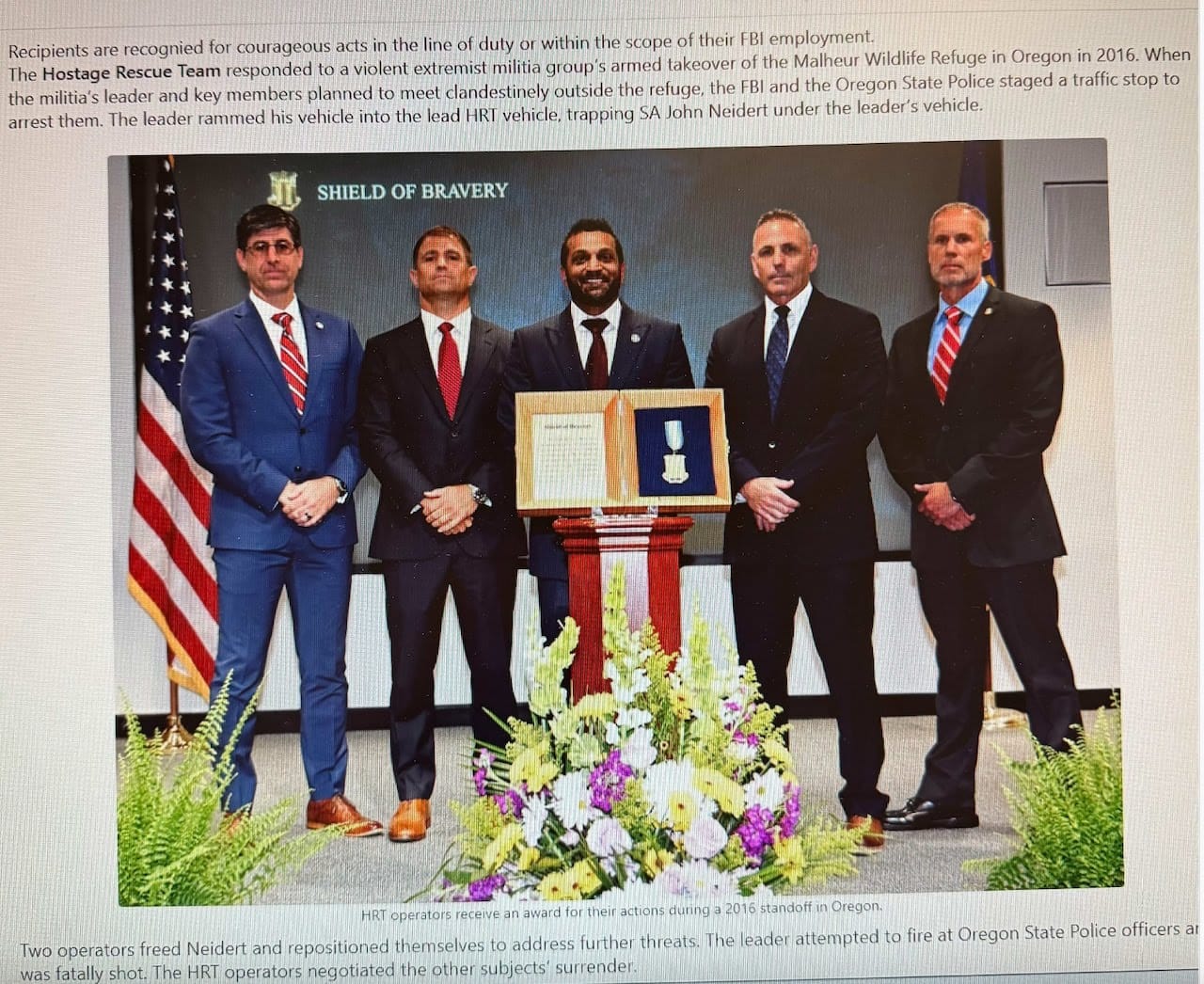
The political and emotional weight of the incident resurfaced sharply when journalist Maxine Bernstein of The Oregonian/OregonLive broke the news that FBI Director Kash Patel had presented the agency's Shield of Bravery to HRT members involved in the 2016 operation, including Agent Astarita and three unnamed agents.
The awards drew swift condemnation from occupation figures, supporters, and the Finicum family.
Family spokesperson Mark Herr noted that honoring the team reopened deep wounds, particularly given the unresolved evidence discrepancies and the prior dismissal of the family's federal civil suit.
Jeanette Finicum publicly decried the commendations as a stark reflection of unaddressed government errors and ongoing institutional protection.
The status of those commendations remains a point of direct conflict. In a personal interview last month with R. Gene Miller and myself, Jeanette stated that Utah Senator Mike Lee's office assured her that the FBI Shield of Bravery awards had indeed been rescinded following the public outcry.
While federal records and official FBI press statements continue to classify the commendations strictly as an internal personnel matter without public confirmation of a revocation, the gap between official silence and private assurances ensures that the pursuit of full transparency around the Malheur operation remains unfinished.
The Unbroken Pattern of Institutional Shielding
What began on a remote stretch of Oregon highway as an attempted arrest has evolved into a case study in systemic self-preservation.
From purged state discipline records and swift executive promotions to unrecovered crime scene evidence and quiet, high-level commendations, the handling of the Highway 395 operation demonstrates how government institutions insulate themselves from public scrutiny.
Whether through official silence, disputed honors, or private assurances delivered behind closed doors, the unanswered shots fired in Harney County continue to demand a standard of transparency that federal and state authorities have yet to deliver.
Image: Maxine Bernstein, Oregonian/OregonLive, August 2025. FBI honors agents involved in LaVoy Finicum death with bravery medal
https://www-oregonlive-com.cdn.ampproject.org/v/s/www.oregonlive.com/crime/2025/08/fbi-honors-agents-involved-in-lavoy-finicum-standoff-with-bravery-medal.html?amp_gsa=1&_js_v=a9&outputType=amp&usqp=mq331AQIUAKwASCAAgM%3D#amp_tf=From%20%251%24s&aoh=17851168370476&referrer=https%3A%2F%2Fwww.google.com&share=https%3A%2F%2Fwww.oregonlive.com%2Fcrime%2F2025%2F08%2Ffbi-honors-agents-involved-in-lavoy-finicum-standoff-with-bravery-medal.html
— Vincent Easley II https://reallibertymedia.com/author/https-reallibertymedia-com-author-vine