
Occupation on National Lands.
The secret to solving the national homeless crisis.
The Federal Land Policy and Management Act of 1976 officially repealed the Homestead Act of 1862 across the 48 contiguous United States. However, it was not immediately repealed in Alaska, which was an organized, incorporated territory before statehood. The government granted a 10-year extension in Alaska, allowing homesteading claims to continue there until it was finally discontinued in 1986. Often people ask me "why is there so much free land but it's not really free?" The answer I give to them is, "imagine a government so pressured to restrict and protect all private land that we call national forests for the sole purpose of reserving resources."
That land belongs to the people of the United States and constitutionally restricted for that purpose of emergency conditions.
Let's look into the history of private land taken for public use under strict scrutiny. The secret to national land and its purpose to provide for a people who are labeled through modern governance and constitutional legal statutory law plain text. First, most free land holders go above and beyond to claim national land for free. When in reality they do not need to go above and beyond unless they have truly authorized their Status to federal citizenship, which makes it even harder to claim free land from the federal government. Free land holders often use--The Homestead Act of 1862 in historical demonstration an earn the nickname "squatters:" Granted 160 acres of public land to citizens who farmed and improved it for five years. Then came the Timber Culture Act of 1873: Offered an additional 160 acres to homesteaders who planted and maintained trees on a portion of the land. Then came the Desert Land Act of 1877: Allowed settlers to buy up to 640 acres of arid land cheaply if they irrigated it. Then came Kinkaid Amendment (1904): Provided 640-acre homesteads specifically in western Nebraska to accommodate cattle ranching. Then came the Enlarged Homestead Act of 1909: Increased the allotment to 320 acres for non-irrigable, dry-farming land. Then came the Newlands Reclamation Act of 1902: Funded large-scale western irrigation and water diversion projects using public-land sales. Then came the Antiquities Act of 1906: Empowered the president to designate historic landmarks and scientific areas as national monuments. Then came Stock-Raising Homestead Act of 1916: Authorized 640-acre homesteads for livestock grazing while explicitly separating surface rights from subsurface mineral rights. Then came the Mineral Leasing Act of 1920: Ended outright disposal of public mineral deposits, establishing a federal leasing system for oil, gas, and coal extraction. Then out came the Taylor Grazing Act of 1934: Created regulated grazing districts on public range lands to halt overgrazing and soil erosion. The Multiple-Use Sustained-Yield Act of 1960: Mandated that national forests be managed concurrently for outdoor recreation, range, timber, watershed, and wildlife. National Environmental Policy Act (NEPA) of 1969: Required federal agencies to conduct formal environmental reviews before authorizing projects or issuing leases on public lands. Endangered Species Act of 1973: Protected critical habitats of threatened and endangered species across federal and non-federal lands. Federal Land Policy and Management Act (FLPMA) of 1976: Repealed the Homestead Act for the lower 48 states, declared a permanent policy of federal land retention, and served as the organic act for the Bureau of Land Management. National Forest Management Act of 1976: Required comprehensive, science-based economic and environmental land-use planning for the National Forest System.Alaska National Interest Lands Conservation Act (ANILCA) of 1980: Protected over 100 million acres of Alaskan ecosystems as national parks, refuges, and wilderness areas while ending standard homesteading in Alaska by 1986.
The truth is when the forest service came along Congress had still restricted themselves to the Law of the Land when creating modern law. The legal language in U.S forest law honors and protects traditional constitutional language on purpose. The reason you don't see language in U.S laws regarding national forest occupation that out right blatantly denies use of the land for purpose of living, such as, for survival or emergency conditions is because that is the sole intent purpose of the national Land: survival of America. Therefore it already belongs to us. It's just the fact the we have to traditionally execute legal conduct to occupy the land Constitutionally and bring ourselves under the law of the land along with understanding the forest service who are for the purpose of reasonable regulation. Personally I could do without some To keep the land in its natural environment. Which means our use of it would be to enhance the natural environment as well. Nothing in U.S forest service law prohibits the use of the land for temporary shelter during emergency conditions. And this is where it gets tricky. The U.S actually permits the use of the National land with or without a permit for temporary occupation, including the crafting of temporary shelter. The U.S government never took the right to establish shelter on National land, or we the peoples private land, taken for imminent domain.
In fact as the population grew on America the government followed the Constitution and decided to only regulate commercial activities. Not the activity at the founding of The United States. When humanity became innovative the government decided to become innovated along with them. As a people we established government and participate in government as government so we are government. The legal languages in law are defined accordingly to constitutional rights. The Law of Rights. Our Rights at the foundational foot of this nation, The United States created law. And for law to be defined in its legal definitions would to accurately accumulate historical definitions of language not used in statute and language used in statutes.
One might say, "what if a ranger comes to the forest that's public and sees I built a home?"
I would say, "What if your home is a temporary shelter in the legal system?"
The federal government never took our land from us to use for personal conveyance, as to being able to survive.
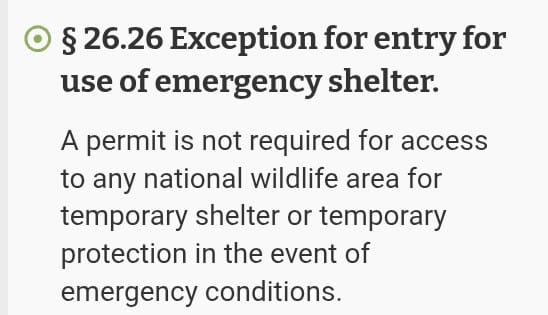
Under 50 CFR § 26.26, a permit is not required to access any national wildlife area for temporary shelter or temporary protection during emergency conditions. If everyone in oregon knew this they would start doing this. The problem is the club of forest fire starters would run them out if they found out about 50 CFR §26.26.
During the 1700s, pioneers often lived in makeshift shelters or rudimentary single-pen cabins while clearing land and building permanent homes.
From the start, log cabins were considered temporary shelter—something to be replaced by more traditional structures as soon as possible.
These early cabins were not meant to be permanent structures. They were designed to serve as temporary shelter for five to ten years, allowing the family time ...
Lacking a home is a critical emergency that severely impacts health and safety, requiring immediate crisis support and temporary shelter. Following with potential State of Emergency: Some city and state governments formally declare states of emergency over homelessness to bypass red tape, speed up funding, and convert buildings into National Alliance to End Homelessness shelter beds.
Some homeless people who refuse to live the modern way refuse homeless centers and modern world thinking. Because it does not serve them self gratitude. Some want to earn and can't earn. Some want to go to the woods and get ran out without citing 50 CFR §26.26.
It is an on going event of being without a home in the modern legal world of law. And it is an emergency condition.
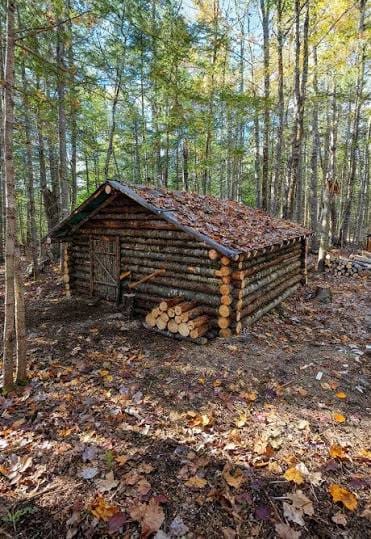
Creating a temporary log shelter during these conditions are supported by Congress and the government as long as the shelters aren't built with permanent material but the material of the environment in which it stands.
The smartest move one can make is to appeal to remote environments and use 50 CFR §26.26 to his advantage during emergency conditions. To avoid wildfires caused by government agencies to run you out or ran out by moderate people in general.
Many frown on this type of preparation for thought. To survive legally and traditionally by method from the founding of The United States.
Many are unaware on what conduct they may legally engage in according to their real estate, financial status, or even religion.
One could Lawfully live within the articles and Amendments and not have any difficulty providing themselves food or even shelter without contracting their legal status to corporate banks, to potentially be replaced by a debt. Only the willing can survive and occupy land for temporary shelter and later claim that land under the books.
Their are members of the government who do not want us to know these truths of our wonderful Congressional members who make the legal alive when it is dead. What is legal conduct cannot be forbidden.
Notice
Of purpose

This page is for judicial insider research and view by Jeremiah David Powers Jr.
Personal page:https://reallibertymedia.com/author/jeremiah
Email me for feedback: jeremiahpowers21@gmail.com In respect to reallibertymedia.com