TESTIMONY UNDER OATH ☆ PATTERNS OF COVER-UP
When federal agents and state troopers ambushed LaVoy Finicum, they set off a chain of institutional deception that continues to unravel years later.
In my previous coverage, Unanswered Shots: The Astarita Trial and the Quest for Accountability exposed the missing brass, the unexplained trajectory angles, and the FBI's desperate attempt to account for rounds they swore were never fired. https://reallibertymedia.com/unanswered-shots-the-astarita-trial-and-the-quest-for-accountability
Following that, Beyond the Verdict: Disputed Weapons, Promotions, and Rescinded Medals tracked how authorities responded to those failures with quiet executive promotions, purged discipline files, and unearned commendations. https://reallibertymedia.com/beyond-the-verdict-disputed-weapons-promotions-and-rescinded-medals
Now, footage from Day 4 of the Astarita trial on July 27th, 2018 brings Jeanette's own voice into the record regarding the killing of LaVoy Finicum—offering her full, unvarnished account directly alongside the courtroom proceedings to expose the stark divide between what was claimed under oath and what actually happened.
This raw counter-perspective cuts through the defense's strategy. As defense attorneys worked to establish reasonable doubt around Officer Joseph Astarita's actions, Jeanette’s reactions highlight what she views as a persistent pattern of deflection—an effort not to uncover the truth of what happened on Highway 395, but to insulate individual operators and the agency itself from criminal liability.
Throughout the proceedings, defense counsel focused heavily on the chaotic nature of the scene, the presence of multiple shooters, and the inherent difficulty of forensic attribution after the fact.
But from Jeanette’s perspective, that deliberate ambiguity was the point. By casting doubt on who fired which specific rounds, the defense capitalized on procedural gaps and lost evidence—gaps that occurred under the sole custody of the law enforcement agencies being investigated.
Her commentary cuts through the clinical language of expert testimony, redirecting attention to the human cost and the foundational conflict: a man was killed, shots were fired that were never officially accounted for, and the legal mechanism designed to investigate those acts ultimately turned inward to protect its own.
Testimony that day reinforces a central theme of this trial—that the pursuit of legal accountability often runs headlong into an institutional wall designed to absorb shock, diffuse blame, and preserve the official line at all costs.
Inside the courtroom of the Astarita trial, the prosecution and defense worked from a shared script. They painted the occupants of that truck as "armed and dangerous," leaning on pre-planned threat assessments assembled long before anyone set foot on Highway 395 or the refuge.
But outside the courtroom, Jeanette Finicum laid out what the official narrative tried so hard to smooth over: the glaring contradictions between what law enforcement claimed under oath and what actually happened on that snow-covered stretch of road.
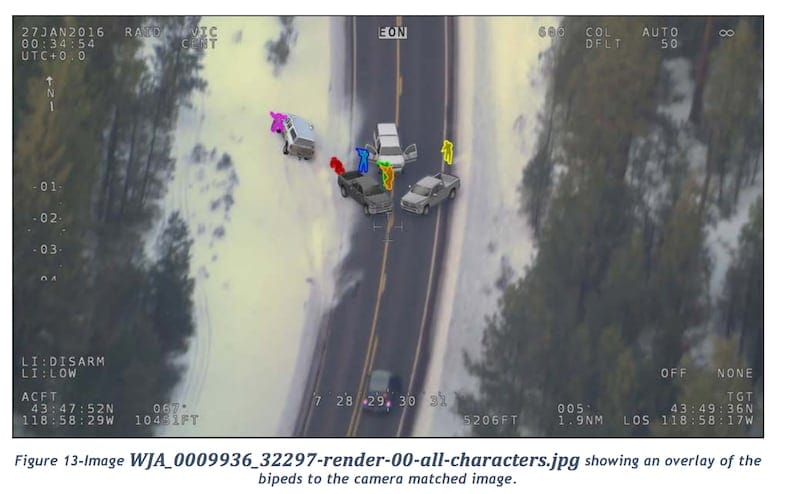
The testimony from FBI agents and Oregon State Police officers only widened the fracture in the government’s story. Take the moment LaVoy’s truck approached the roadblock. Officer after officer testified they heard the engine accelerate—a claim calculated to frame the truck as an oncoming weapon. Yet the aerial and ground footage tells a completely different story.
LaVoy’s brake lights flashed the moment he cleared the blind curve and realized what lay ahead. With roughly twelve seconds to react, his foot stayed on the brake as he steered off the asphalt to avoid a collision.
When he swerved left, FBI Agent John Neider leaped to the right—directly into the truck's path. LaVoy jerked the wheel even further left at the very last second, burying the truck in a snowbank to avoid striking the officer.
The state framed it as an attempted vehicular assault; Jeanette recognized it for what it was—a man doing everything in his power, in his final seconds of life, to avoid taking a human life.
Then came the physical evidence, or rather, its deliberate disappearance.
During testimony, two officers—FBI Agent "BM" and Agent John Neider—admitted to seeing a spent shell casing sitting on the ground right in the center of the "V" formation roadblock.
Conversations on scene captured agents debating whether the brass came from a .308 or a 5.56 round, trying to pin down whose gun had fired. But when crime scene technicians processed the area, that shell casing was gone. It simply vanished into thin air.
That disappearing casing aligns directly with another admission squeezed out during Day 4: the FBI’s choice to break standard protocol during the initial investigation. Instead of interviewing the five Hostage Rescue Team operators individually—the bedrock standard for any serious inquiry to prevent story-aligning—the FBI insisted on a group interview.
As testimony acknowledged, group interviews create severe blind spots, allowing agents to hear each other's responses, align their stories, or cover for someone who stepped out of line.
Perhaps the most revealing moment of the day came when OSP Officer 2 took the stand to explain the tactical force used before the lethal rounds were fired. He defined non-lethal impact munitions—rubber or sponge rounds—as a "momentary pain controller."
That single phrase cuts through years of official spin.
When LaVoy stepped out of the truck into the deep snow with his hands in the air, visual footage showed him flinching and reaching toward his torso.
The government used those physical reactions to claim he was reaching for a weapon inside his jacket. But an involuntary reaction to a "momentary pain controller" striking his body isn't a reach for a gun—it is a human body responding to pain.
Officers used the very movement their non-lethal rounds forced him to make as their justification to fire three fatal rounds into his back while his hands were still up.
The court proceedings revealed that the planning for this fatal encounter did not start on the fly. Testimony established that a joint task force—combining the FBI, HRT, OSP, BLM, and the Forest Service—assembled back in December 2015, weeks before the Malheur Refuge demonstration even began.
They operated on inflated threat assessments, hyped up on narratives that treated articulate spokesmen as high-level military threats.
While W. Joseph Astarita stood trial specifically for false statements and obstruction of justice regarding his unacknowledged shots, the broader picture exposed a systemic failure.
The deliberate framing, the missing brass on the roadway, the irregular group interviews, and the immediate resort to lethal force reveal a machine protecting itself at all costs.
Jeanette’s commentary wasn't just a reaction to a day in court—it was a direct call out of an institutional cover-up that continues to demand real accountability.
https://reallibertymedia.com/testimony-under-oath-patterns-of-cover-up/
Reference: https://www.youtube.com/live/bQnVx6mqKfs?is=ldw-4iIRLvkgbW3o
— Vincent Easley II https://reallibertymedia.com/author/https-reallibertymedia-com-author-vine
Image: Grand Jury Transcripts Give New Insight Into Finicum Shooting By Conrad Wilson (OPB) Portland, Ore. April 15, 2018 https://www.opb.org/news/series/burns-oregon-standoff-bundy-militia-news-updates/lavoy-finicum-shooting-joe-astarita-oregon-standoff-grand-jury