
The Anatomy of Manufactured Division
How Label-Driven Rhetoric and Policy Warfare Obscure the Real Battle Over Constitutional Authority
Terms like "welfare rancher," "racist," "white supremacist," and "extremist" are deployed with a precise purpose: to reduce complex constitutional and legal disputes down to simple personal attacks.
Dismissing these conflicts with label-driven attacks relies on ad hominem fallacies and false dilemmas, replacing critical analysis with emotional broad strokes. Conflating a critique of government action with approval of an individual's worldview misses the core principle: constitutional protections exist to check authority, regardless of who is involved.
The conviction that one's own perspective is the sole truth represents a profound intellectual limitation.
When a single vantage point is treated as absolute, genuine debate ceases and dogma takes over.
Cultural polarization and intentional division drive people to isolate themselves from societal norms and adopt independent worldviews.
When people or communities feel threatened or alienated by mainstream culture, separatism can sometimes become a reaction, which may push individuals toward the margins as a defense mechanism.
Those derogatory labels—whether weaponized in the framing surrounding Ruby Ridge or targeted at the figures involved at the Bundy Ranch Protest—are systematically cataloged and amplified by non-governmental organizations like the Southern Poverty Law Center.
By assigning designations like "domestic terrorist" or "antigovernment extremist," these organizations produce official-sounding registries that are fed directly into media narratives and law enforcement frameworks.
Stripping away public sympathy shifts focus away from systemic government overreach and makes aggressive federal action far more acceptable to the mainstream.
This pattern extends directly across high-profile events, including the 2016 occupation of the Malheur National Wildlife Refuge and broader Western land disputes.
Non-governmental organizations and federal agencies frequently leverage these dynamics to frame traditional land use—whether in Western ranching, logging, or water rights—as radicalism.
Top-down environmental regulations and administrative mandates are then used to bypass local sovereignty, undercut working families, and dispossess rural communities of their livelihoods.
Understanding how cultural conflict, regulatory overreach, and strategic labeling are deployed reveals the broader strategy at play:
isolating independent movements, manufacturing public consent through character assassination, and consolidating central control under the guise of the public good.
Reclaiming individual sovereignty and constitutional boundaries requires rejecting the prepackaged caricatures designed to divide the public.
So long as federal entities and allied organizations can successfully substitute smear campaigns for lawful debate, the fundamental erosion of local authority and individual liberty will continue unchecked.
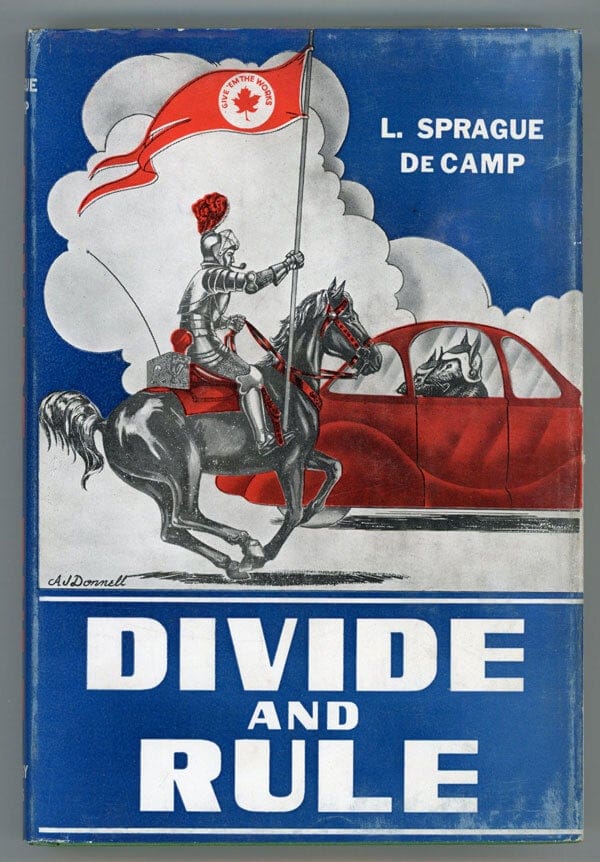
About the image: Divide and Rule by L. Sprague de Camp is a science fiction story set nearly three centuries after Earth was conquered by advanced, kangaroo-like alien overlords nicknamed "hoppers." To maintain control, the aliens intentionally suppressed human scientific knowledge and reorganized society into a balkanized feudal class system, ensuring humanity remains too fragmented and technologically primitive to stage a unified rebellion.
The narrative follows Sir Howard van Slyck, a young, naive knight errant who initially accepts this rigid social hierarchy. However, after his brother is arrested for committing heresy by conducting secret scientific research, Howard is drawn into the human underground resistance movement. Forced to question his upbringing, he must navigate alien intrigue, unlearn his aristocratic prejudices, and help turn the hoppers' tactics of division back against them.
— Vincent Easley II https://reallibertymedia.com/author/https-reallibertymedia-com-author-vine